
In short: From 17 November 2026, NSW agents must base price estimates on a set method using three comparable sales, and every residential sale ad needs a price or range. From February 2027, buyers also get a Statement of Information listing those comparables. Court penalties for underquoting now go up to $110,000 or three times the agent’s commission, whichever is higher.
Be honest. How many times have you seen a home “guided at $900k” sell for $1.05 million?
You weren’t bad at maths. You’d been underquoted.
Warren Buffett once said, “Price is what you pay. Value is what you get.” With some Sydney price guides, you could add a third line: “And the guide is what you were told.”
From 17 November 2026, NSW is making its most serious attempt yet to fix this. So will a price guide finally mean something?
So what’s actually changing?
The new laws come in three waves:
| Date | What starts |
|---|---|
| 29 June 2026 | Higher penalties and stronger Fair Trading powers (already in force) |
| 17 November 2026 | Comparable-sales method, price in every ad, new record-keeping |
| 8 February 2027 | Statement of Information for buyers |
No more pulling a number out of thin air?
Price estimates now need a method:
- Metropolitan areas (Greater Sydney, plus the Central Coast, Newcastle, Wollongong and the Blue Mountains: full list here): sales within 2 km over the last 6 months, or 12 months if there aren’t three.
- Everywhere else: sales within 5 km over the last 18 months.
- The agent picks the three most comparable, judged on things like dwelling type, size, condition, land size and even school catchment.
The estimate has to take those sold prices into account. In plain English: “I reckon it’s worth about…” now needs receipts.
Trust, but verify. From 17 November, that’s the new deal with price guides.
Does every ad need a price now?
Yes, for residential sale ads published from 17 November. No more “Contact agent” with a wink. (The for-sale sign out the front is exempt, unless it shows a price.)
The advertised price also can’t be lower than the agent’s estimate, the highest bid if the property passed in at auction, or a written offer the seller rejected only because it was too low. If an online ad stops complying, the agent must take reasonable steps to fix or remove it within one business day.
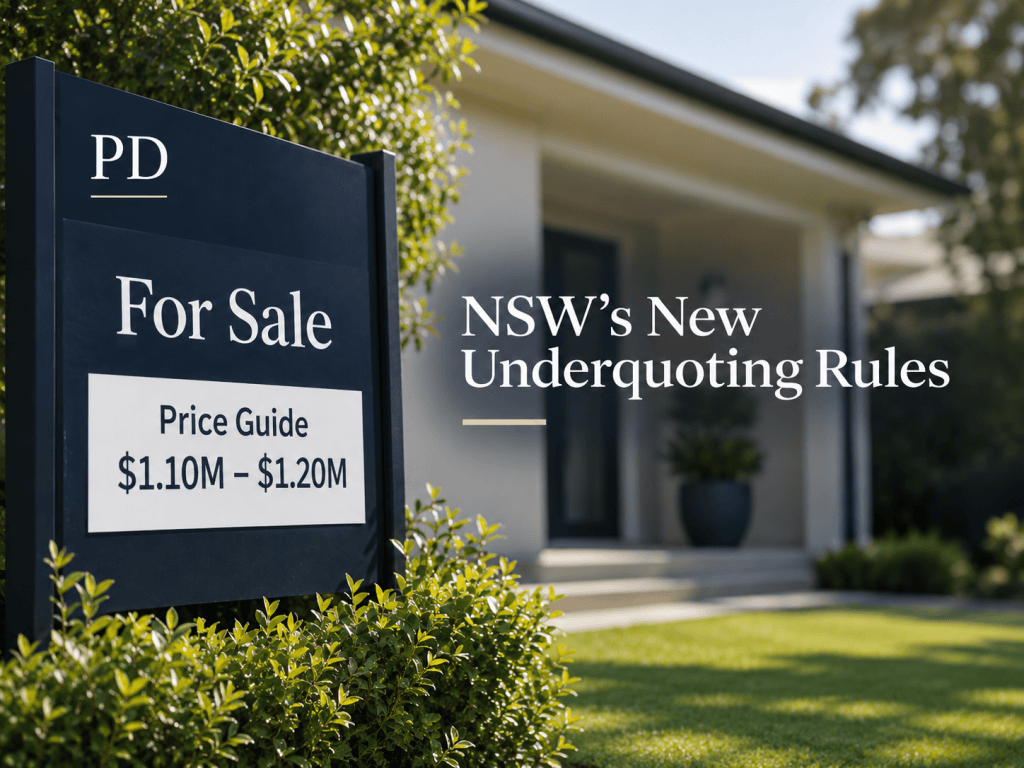
And Fair Trading’s current guidance still says a range can’t be wider than 10%. So $1.1M to $1.2M is fine. $1.1M to $1.3M is not.
Does the seller have to accept the bottom of the range?
No. I get asked this a lot. The seller can say no to any offer. The ad only has to change when all three of these are true:
- the offer is in writing,
- the seller rejects it only because it’s too low, and
- it’s above the bottom of the advertised price.
Say the guide is $1.1M to $1.2M. A written $1.15M offer rejected as too low means the ad can’t keep saying $1.1M. A $1.0M offer, or one rejected over settlement terms, changes nothing.
Won’t buyers just offer the bottom number?
Some will. Buyers have always anchored to the low end. The difference now is that the bottom number is backed by real sales, so it’s a genuine price, not a teaser.
And one offer doesn’t set the price. Competition does. When a second buyer offers $1.15M, the bottom number stops mattering. A tight range, a single price, an auction or a closing date for offers all help.
What else is coming, and does it bite?
For agency agreements signed after 8 February 2027, agents must also prepare a Statement of Information listing the comparable sales. It goes in the online ad, on display at inspections, and to buyers within two business days if they ask. For the first time, buyers can see the homework behind the number.
The penalties bite too. Underquoting can cost an agent up to $110,000 in court, or three times their commission, whichever is higher.
What I’m seeing on the ground
Here’s the funny part. Buyers complain to me about low guides all the time. Then, a few years later, the same people sell, and suddenly they want every buyer in Sydney at the open home.
I get it. Nobody wants to leave money on the table. But a great result doesn’t come from a misleading guide. It comes from competition: good marketing, a realistic price that brings in serious buyers, and a few of them wanting the same home. The new rules just mean everyone starts from an honest number.
I also expect some awkward chats with sellers who were told $1.3M by a mate at a barbecue, when three real sales say otherwise.
What it means for you
Buying: Treat the guide as a real starting point, and ask which comparables the agent used. Do your own homework too. A home can still sell well above its range if two buyers fall in love with it.
Selling: Expect evidence before you sign. You still decide whether to sell. Be wary of any agent who quotes a big number with no sales behind it. That’s the old game, just aimed at you.
The bottom line
Will price guides finally mean something? I think they’ll mean a lot more than they used to.
The good agents already price from real sales and tell sellers the truth. These rules make everyone else do the same. Hot properties will still blow past their guides, but “Contact agent” and the $900k guide that sells for $1.05M should be on their way out. I won’t miss them.
Enjoyed this? Subscribe to The Property Desk for a new article every Friday. Sydney property, explained.
Disclaimer: This article is general information only, not legal or financial advice. It doesn’t take your personal circumstances into account. For advice on your situation, speak to a solicitor or licensed professional, and check the latest rules with NSW Fair Trading.


Leave a Reply